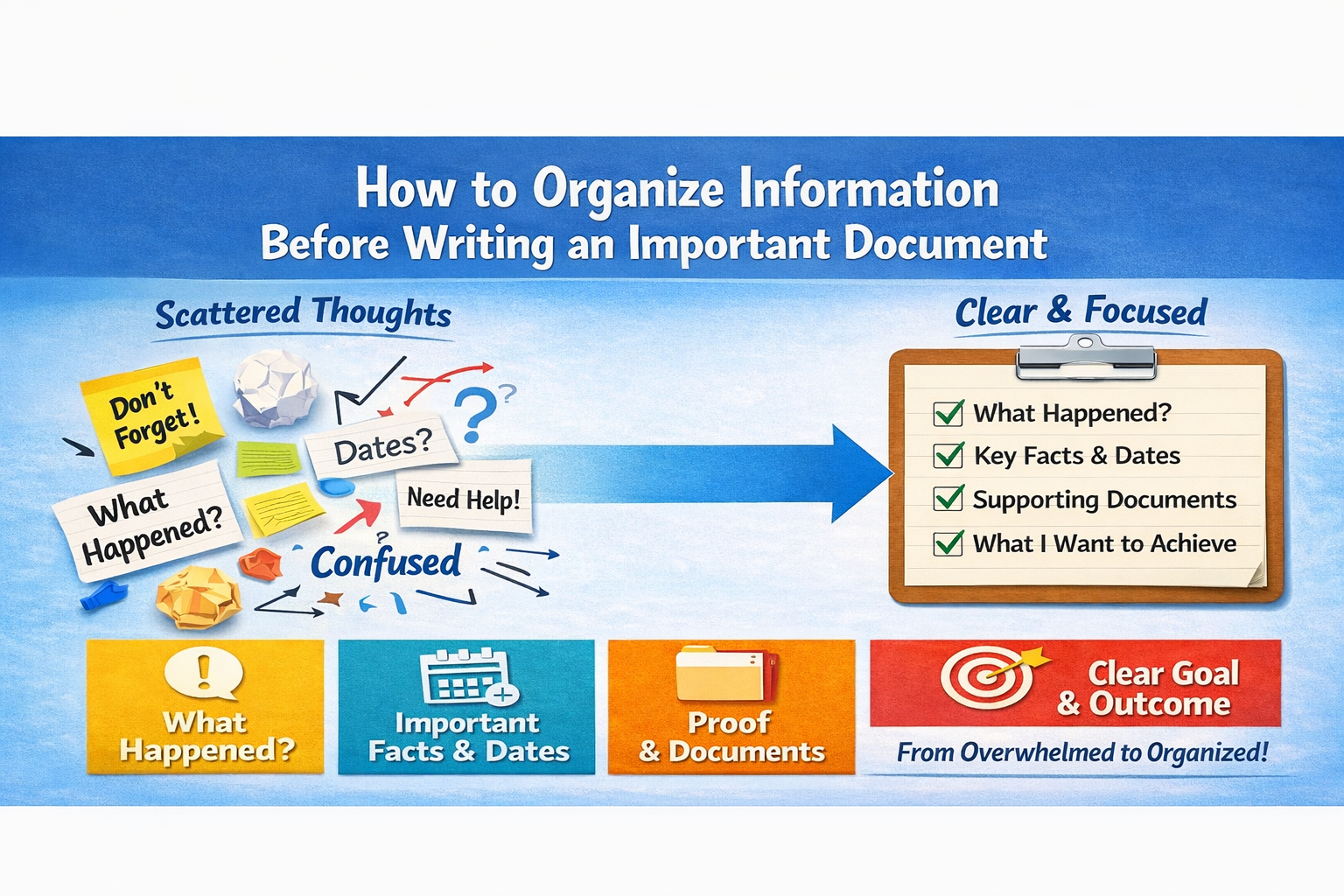
How to Organize Information Before Writing an Important Document

Turn Scattered Thoughts, Notes, and Stress Into Clear Information That Is Easier to Write and Easier for Others to Understand

When people sit down to write an important document, most of the time they are not struggling because they do not know how to write.

They are struggling because they have too much information in their head all at once.

They are thinking about what happened, what they are feeling, what they forgot to mention, what they want to say, what they should leave out, what order things should go in, and whether the person reading it will even understand it.

That is where most people get stuck.

Before you ever start writing, the most important thing you can do is organize your information first.

A clear document almost always starts with clear notes.

Why People Struggle With Important Documents

Most people try to write while they are still sorting through their thoughts.

That usually leads to:

  • Jumping around from topic to topic
  • Repeating the same point several times
  • Leaving out important details
  • Adding emotional details that do not help
  • Forgetting dates, names, or timelines
  • Making the reader work too hard to understand the situation

Whether you are writing an unemployment appeal, hardship letter, business plan, complaint letter, grant application, resume, or formal explanation, the same rule applies:

The clearer your information is before you start writing, the stronger the final document will be.

Start With These Four Questions

Before you write anything important, stop and answer these four questions:

1. What happened?

Write down the situation in the simplest possible way.

Do not worry about perfect grammar. Do not try to sound professional yet.

Just explain the situation plainly.

Example:

“I lost my job after a misunderstanding with a supervisor and now I need to explain why I should qualify for unemployment benefits.”

Or:

“I want to start a business, but I have too many ideas and do not know how to organize them into a business plan.”

2. What are the most important facts?

Once you know the main situation, start listing the key facts.

This may include:

  • Dates
  • Names
  • Timeline of events
  • Important conversations
  • Documents you already have
  • Money amounts
  • Deadlines
  • Policies or rules
  • Any evidence that supports your side

This is where many people realize they know more than they think they do.

3. What outcome do you want?

Many people spend so much time explaining the problem that they forget to clearly explain what they want.

Ask yourself:

  • Do I want approval?
  • Do I want reconsideration?
  • Do I want someone to understand my side?
  • Do I want an interview?
  • Do I want funding?
  • Do I want the reader to take a specific action?

If you do not know your desired outcome, the document will feel scattered.

A Simple Framework You Can Follow

Most important documents can be organized into four sections:

  1. What happened
  2. Important facts and timeline
  3. Supporting documents or evidence
  4. What you are asking for

That simple structure works for almost everything.

It works for:

  • Unemployment appeals
  • Hardship letters
  • Business plans
  • Complaint letters
  • Grant applications
  • Professional emails
  • Government paperwork
  • Resumes and cover letters
  • School or housing letters

Create a Master List Before You Write

One of the easiest ways to reduce stress is to create what I call a “master list.”

Your master list is simply a rough list of every important detail you can think of before you start writing.

You can include:

  • Names
  • Dates
  • Important events
  • Supporting documents
  • Questions you need answered
  • Points you do not want to forget
  • Specific phrases you want included
  • Contact information
  • Deadlines
  • Next steps

Once everything is written down in one place, your brain no longer has to keep trying to remember it all at once.

That makes writing much easier.

Why This Matters

Decision-makers do not spend hours trying to figure out what you mean.

Whether it is a hiring manager, judge, grant reviewer, government office, lender, landlord, or business owner, most people are quickly scanning for:

  • What happened
  • Why it matters
  • What proof exists
  • What you want them to do

The easier you make that process, the better your chances of getting a positive result.

Good writing is not just about grammar.

It is about clarity, structure, and helping the reader understand what matters most.

If you organize your information before you write, you will save time, reduce stress, and create documents that are much more likely to get results. One document at a time.


Stacey Brooks Thego2writer

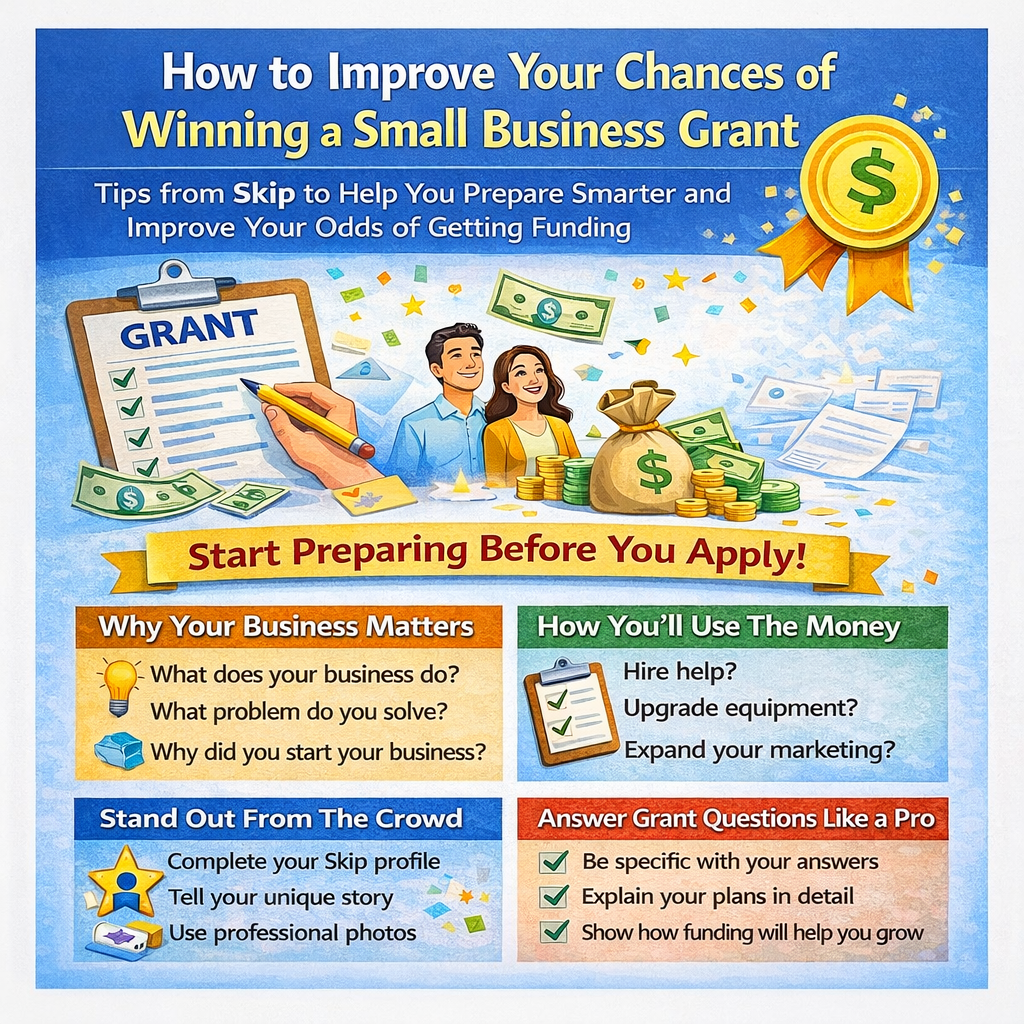
How to Improve Your Chances of Winning a Small Business Grant

Tips From Skip to Help You Prepare Smarter and Improve Your Odds of Getting Funding

Many people think grants are all about luck.They believe you either get picked or you do not. The truth is that most grant applications are won or lost long before a judge ever reads the final answers.

The businesses that stand out are usually the ones that are prepared.

They know what they do, who they help, why they matter, and how they plan to use the money.

That is especially true on platforms like Skip where business owners are often competing against hundreds or even thousands of other applicants.

The Biggest Mistake Most People Make

One of the biggest mistakes people make is waiting until the last minute to apply.

They rush through the questions, write very short answers, forget to explain their business clearly, and do not provide enough detail about how the money would actually be used.

A weak answer often sounds something like this:

“I would use the grant to grow my business.”

That is too vague.

A stronger answer sounds more like this:

“I would use the grant to improve my website, purchase marketing materials, upgrade software, pay for advertising, and improve my business visibility so I can attract more clients and increase revenue.”

Grant reviewers want to know exactly how the money will make a difference.

What Grant Reviewers Are Usually Looking For

Most grant reviewers are looking for five things:

  1. A clear explanation of what your business does
  2. A specific problem your business solves
  3. A strong reason your business matters
  4. A realistic plan for using the money
  5. A business owner who seems serious, prepared, and committed

That means you do not need the biggest business, the fanciest website, or the most money to win.

You need clarity.

How to Strengthen Your Grant Answers

Before you apply for any grant, take time to organize your information.

Start with these questions:

  • What does your business do?
  • Who do you help?
  • What problem do you solve?
  • Why did you start your business?
  • What makes your business different?
  • How would you use the money?
  • What results would the funding help you achieve?

When you answer those questions first, your grant application becomes much easier to write.

Why Specific Answers Matter

The strongest grant answers usually include details.

Instead of saying:

“I need money for my business.”

Try something like:

“I would use the grant to purchase a new laptop, improve my website, pay for business cards and marketing materials, invest in advertising, and purchase software that would help me serve more clients more efficiently.”

Specific answers make your business feel more real.

They help reviewers picture exactly what the funding would do.

Why Your Business Story Matters

Many people skip over the story behind their business because they think it is not important.

It is important.

People remember stories more than they remember generic facts.

If you started your business because you saw a need, overcame a struggle, wanted to help others, or turned a personal experience into a service, that matters.

Grant reviewers often connect with business owners who have a genuine reason behind what they do.

For example, a business owner who says:

“I started my business because I know what it feels like to be overwhelmed, stressed, and unsure how to put important information into words.”

will usually stand out more than someone who says:

“I started a writing business because I like writing.”

Why Your Skip Profile Matters

If you are using Skip, your business profile matters just as much as your application answers.

A complete profile helps show that you are serious about your business.

Your profile should include:

  • A clear business description
  • Professional profile photos
  • Strong service descriptions
  • Good product or service images
  • Updated contact information
  • A clear explanation of who you help and what you offer

A weak profile can make even a strong application feel incomplete.

A strong profile makes your business look more established and trustworthy.

Ways to Make Your Grant Application Stronger

Before you submit your next grant application, ask yourself:

  • Did I fully explain my business?
  • Did I clearly explain how I would use the money?
  • Did I give enough detail?
  • Did I explain why my business matters?
  • Did I show how the grant would help me grow?
  • Did I make it easy for someone to understand my business quickly?

Those small improvements can make a major difference.

Final Thoughts

Winning grants is not only about luck.

It is about preparation, clarity, organization, and making it easy for people to understand why your business deserves support.

The stronger your answers are, the stronger your chances become.

If your business feels hard to explain, overwhelming, or difficult to organize, start there first.

Because when your business is clear, your grant application becomes much stronger too.


Stacey Brooks Thego2writer
This Valentine’s Day, Say It the Right Way

Today is about love.
Love for your spouse.
Love for your children.
Love for your business.
Love for the dream you are still building.
Sometimes the most important words are the hardest to write.
If there is something you have been meaning to say but have not known how to put into words, that is where I come in.
Whether it is:
• A professional resume, cover letter, or LinkedIn profile that needs to reflect your true experience and value
• A business plan, proposal, bio, or mission statement that needs structure and clarity
• A legal letter, appeal, formal complaint, or important response that must be written carefully and correctly
• A heartfelt letter to someone you love that feels difficult to put into words
• A personal statement for school, a scholarship, or a new opportunity
• Help organizing scattered thoughts into a clear, confident message
I help you say it the right way.
With clarity.
With professionalism.
With purpose.
This Valentine’s Day, give yourself the gift of confidence in your words. If something has been sitting unfinished, overwhelming, or weighing on you, message me. Let’s turn it into something strong, polished, and ready to send.
Follow this page for writing support, encouragement, and practical guidance.
Stacey Brooks | TheGo2Writer

When Words Matter Most: How to Write Clearly in High-Pressure Situations

There are moments when writing is not optional.

It is not creative.
It is not casual.
It is necessary.

A resignation letter.
An appeal.
A complaint.
A formal request.
A response to an accusation.
A message to a school, employer, agency, landlord, client.

And in those moments, emotions are high. Thoughts are scattered. Stakes feel heavy.

This is where most people struggle.

Not because they lack intelligence.
Not because they do not know what happened.
But because pressure disrupts clarity.

Today’s post is practical. If you ever have to write something important under stress, here is how to do it well.

1. Separate Emotion From Structure

Emotion belongs in your experience.
Structure belongs in your document.

Before you begin writing the actual message, do this:

On a blank page, answer these three questions only:

  1. What happened?

  2. What do I want?

  3. What outcome would be reasonable?

Keep it short. Bullet points are fine.

This step prevents emotional spirals from overtaking your message. It gives your brain a container.

Once you have those answers, then you write.

2. Use the Professional Formula

Most high-stakes documents follow this simple structure:

Paragraph 1: Purpose
State why you are writing in one or two sentences.

Example:
“I am writing to formally request a review of the recent decision regarding my unemployment benefits.”

Clear. Direct. Calm.

2. Use the Professional Formula

Most high-stakes documents follow this simple structure:

Paragraph 1: Purpose
State why you are writing in one or two sentences.

Example:
“I am writing to formally request a review of the recent decision regarding my unemployment benefits.”

Clear. Direct. Calm.

Specific requests lead to actionable responses.

3. Remove Defensive Language

When people feel wronged, they often write in defense mode.

Phrases like:
“This is unfair.”
“You clearly did not review…”
“I cannot believe…”

These weaken your credibility.

Replace them with:
“According to the documentation provided…”
“Based on the timeline outlined…”
“I respectfully request clarification regarding…”

Calm language increases authority.

The goal is not to win emotionally.

The goal is to be taken seriously.

4. Short Sentences Win

Long paragraphs feel overwhelming to readers, especially decision-makers reviewing dozens of cases.

Keep sentences tight.
Break up paragraphs.
Use white space.

Clarity is kindness to the reader.

If a sentence runs longer than two lines, shorten it.

5. Always Attach Proof

Never rely on your explanation alone.

If you reference:
A payment
A deadline
A prior approval
A contract
A policy

Attach it.

Then reference it clearly in the document:

“See attached email dated January 12, 2026 confirming approval.”

Documentation strengthens your position more than emotion ever will.

6. Let It Sit

If possible, wait 12 to 24 hours before sending.

Re-read and ask:

Is this clear?
Is this respectful?
Is this specific?
Does this document help the reader make a decision?

If the answer is yes, send it confidently.

7. When You Feel Stuck

Sometimes the issue is not grammar.
It is overload.

When someone says, “I do not even know how to start,” what they usually mean is:

“I am carrying too much at once.”

That is not a writing problem.
That is a processing problem.

Break it down.
Extract the facts.
Structure the request.
Then polish the tone.

Writing under pressure is not about being eloquent.
It is about being clear.

Final Thought

The most powerful documents are not loud.
They are steady.

Calm writing communicates credibility.
Structure communicates confidence.
Clarity communicates strength.

And when the stakes are high, strength on paper matters.

If you ever find yourself staring at a blank screen with something important on the line, remember:

You do not have to write perfectly.
You just have to write clearly.

That is what moves things forward.

How I Can Help You Turn Thoughts Into Clear, Professional Writing

Most people don’t struggle because they lack ideas.
They struggle because they’re holding too much at once.

Unfinished thoughts. Emotional weight. Uncertainty about tone. Fear of saying the wrong thing. Important situations where the words actually matter.

That’s where my work begins.

I help individuals, families, and small businesses move from “I don’t know how to say this” to clear, respectful, professional writing that serves its purpose.

Here are the many ways I assist people throughout the writing process.

Professional and Personal Letters

I help write and refine letters that need clarity, tact, and credibility, including:

  • Legal and formal correspondence

  • Employment and workplace letters

  • Letters to schools, agencies, landlords, or organizations

  • Personal letters that still require a professional tone

  • Follow-up, appeal, clarification, or explanation letters

Often, people know what they need to say. They just need help saying it in a way that will be heard.

Business and Professional Documents

I support clients with writing that represents them or their business, such as:

  • Business plans and supporting narratives

  • Mission statements and purpose statements

  • Professional bios and introductions

  • Client communications and proposals

  • Internal documents that need structure and polish

The goal is not fancy language. The goal is clarity, confidence, and credibility.

Editing, Revising, and Strengthening Existing Writing

Many clients come to me with drafts already written. My role may include:

  • Organizing scattered thoughts into a logical flow

  • Improving tone without changing the writer’s voice

  • Clarifying meaning while preserving intent

  • Removing unnecessary wording while strengthening impact

  • Making writing sound calm, professional, and intentional

Sometimes the work is not starting from scratch, but refining what already exists.

Helping When Emotions Are Involved

Some writing situations carry emotional weight. Conflict, stress, fear, or urgency can make it difficult to choose the right words.

I help clients:

  • Separate emotion from message

  • Maintain dignity and respect in difficult situations

  • Communicate clearly without escalating conflict

  • Write in a way that protects their position and their peace

This is especially important when writing affects real outcomes.

Structuring Ideas When You Feel Stuck

For clients who feel overwhelmed or unsure where to begin, I help with:

  • Outlining thoughts before writing begins

  • Identifying the true purpose of the document

  • Deciding what needs to be included and what does not

  • Turning verbal explanations into written form

Clarity often comes before the words themselves.

Guidance Through the Writing Process

I don’t just hand over words. I help people understand the process, including:

  • What tone fits the situation

  • How structure affects perception

  • Why certain wording works better than others

  • How to revise with intention instead of second-guessing

My role is part writer, part translator, part guide.

x  Powerful Protection for WordPress, from Shield Security
This Site Is Protected By
Shield Security