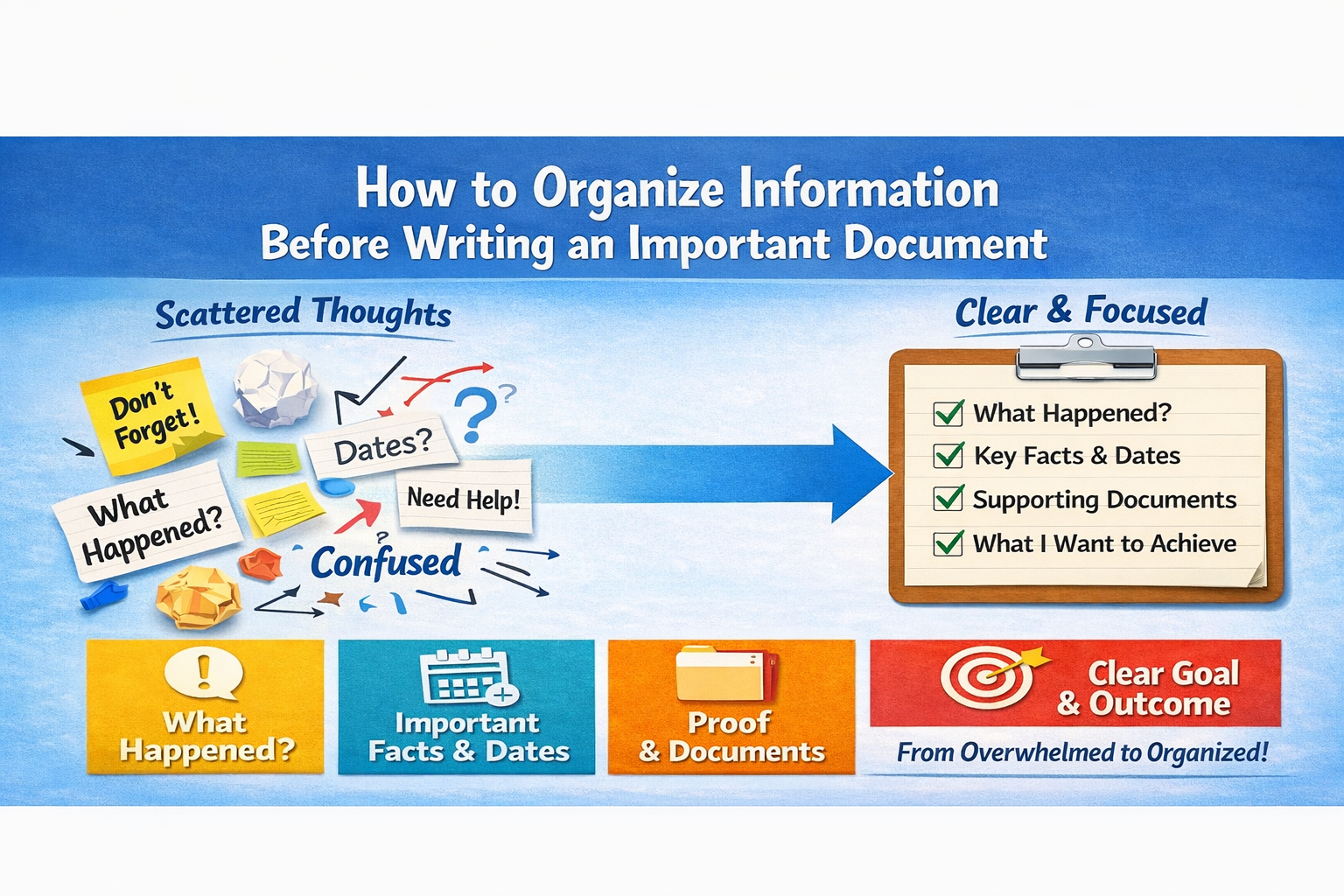
How to Organize Information Before Writing an Important Document

Turn Scattered Thoughts, Notes, and Stress Into Clear Information That Is Easier to Write and Easier for Others to Understand

When people sit down to write an important document, most of the time they are not struggling because they do not know how to write.

They are struggling because they have too much information in their head all at once.

They are thinking about what happened, what they are feeling, what they forgot to mention, what they want to say, what they should leave out, what order things should go in, and whether the person reading it will even understand it.

That is where most people get stuck.

Before you ever start writing, the most important thing you can do is organize your information first.

A clear document almost always starts with clear notes.

Why People Struggle With Important Documents

Most people try to write while they are still sorting through their thoughts.

That usually leads to:

  • Jumping around from topic to topic
  • Repeating the same point several times
  • Leaving out important details
  • Adding emotional details that do not help
  • Forgetting dates, names, or timelines
  • Making the reader work too hard to understand the situation

Whether you are writing an unemployment appeal, hardship letter, business plan, complaint letter, grant application, resume, or formal explanation, the same rule applies:

The clearer your information is before you start writing, the stronger the final document will be.

Start With These Four Questions

Before you write anything important, stop and answer these four questions:

1. What happened?

Write down the situation in the simplest possible way.

Do not worry about perfect grammar. Do not try to sound professional yet.

Just explain the situation plainly.

Example:

“I lost my job after a misunderstanding with a supervisor and now I need to explain why I should qualify for unemployment benefits.”

Or:

“I want to start a business, but I have too many ideas and do not know how to organize them into a business plan.”

2. What are the most important facts?

Once you know the main situation, start listing the key facts.

This may include:

  • Dates
  • Names
  • Timeline of events
  • Important conversations
  • Documents you already have
  • Money amounts
  • Deadlines
  • Policies or rules
  • Any evidence that supports your side

This is where many people realize they know more than they think they do.

3. What outcome do you want?

Many people spend so much time explaining the problem that they forget to clearly explain what they want.

Ask yourself:

  • Do I want approval?
  • Do I want reconsideration?
  • Do I want someone to understand my side?
  • Do I want an interview?
  • Do I want funding?
  • Do I want the reader to take a specific action?

If you do not know your desired outcome, the document will feel scattered.

A Simple Framework You Can Follow

Most important documents can be organized into four sections:

  1. What happened
  2. Important facts and timeline
  3. Supporting documents or evidence
  4. What you are asking for

That simple structure works for almost everything.

It works for:

  • Unemployment appeals
  • Hardship letters
  • Business plans
  • Complaint letters
  • Grant applications
  • Professional emails
  • Government paperwork
  • Resumes and cover letters
  • School or housing letters

Create a Master List Before You Write

One of the easiest ways to reduce stress is to create what I call a “master list.”

Your master list is simply a rough list of every important detail you can think of before you start writing.

You can include:

  • Names
  • Dates
  • Important events
  • Supporting documents
  • Questions you need answered
  • Points you do not want to forget
  • Specific phrases you want included
  • Contact information
  • Deadlines
  • Next steps

Once everything is written down in one place, your brain no longer has to keep trying to remember it all at once.

That makes writing much easier.

Why This Matters

Decision-makers do not spend hours trying to figure out what you mean.

Whether it is a hiring manager, judge, grant reviewer, government office, lender, landlord, or business owner, most people are quickly scanning for:

  • What happened
  • Why it matters
  • What proof exists
  • What you want them to do

The easier you make that process, the better your chances of getting a positive result.

Good writing is not just about grammar.

It is about clarity, structure, and helping the reader understand what matters most.

If you organize your information before you write, you will save time, reduce stress, and create documents that are much more likely to get results. One document at a time.


Stacey Brooks Thego2writer

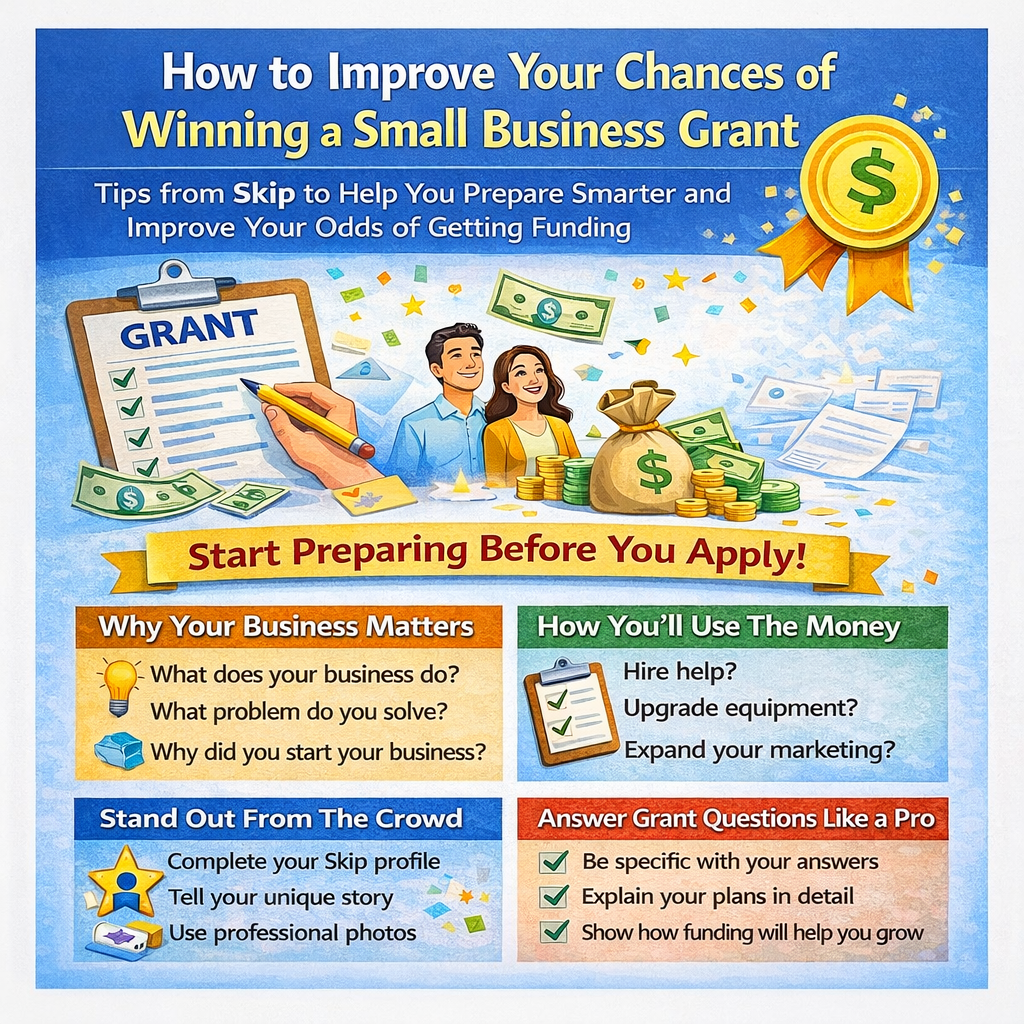
How to Improve Your Chances of Winning a Small Business Grant

Tips From Skip to Help You Prepare Smarter and Improve Your Odds of Getting Funding

Many people think grants are all about luck.They believe you either get picked or you do not. The truth is that most grant applications are won or lost long before a judge ever reads the final answers.

The businesses that stand out are usually the ones that are prepared.

They know what they do, who they help, why they matter, and how they plan to use the money.

That is especially true on platforms like Skip where business owners are often competing against hundreds or even thousands of other applicants.

The Biggest Mistake Most People Make

One of the biggest mistakes people make is waiting until the last minute to apply.

They rush through the questions, write very short answers, forget to explain their business clearly, and do not provide enough detail about how the money would actually be used.

A weak answer often sounds something like this:

“I would use the grant to grow my business.”

That is too vague.

A stronger answer sounds more like this:

“I would use the grant to improve my website, purchase marketing materials, upgrade software, pay for advertising, and improve my business visibility so I can attract more clients and increase revenue.”

Grant reviewers want to know exactly how the money will make a difference.

What Grant Reviewers Are Usually Looking For

Most grant reviewers are looking for five things:

  1. A clear explanation of what your business does
  2. A specific problem your business solves
  3. A strong reason your business matters
  4. A realistic plan for using the money
  5. A business owner who seems serious, prepared, and committed

That means you do not need the biggest business, the fanciest website, or the most money to win.

You need clarity.

How to Strengthen Your Grant Answers

Before you apply for any grant, take time to organize your information.

Start with these questions:

  • What does your business do?
  • Who do you help?
  • What problem do you solve?
  • Why did you start your business?
  • What makes your business different?
  • How would you use the money?
  • What results would the funding help you achieve?

When you answer those questions first, your grant application becomes much easier to write.

Why Specific Answers Matter

The strongest grant answers usually include details.

Instead of saying:

“I need money for my business.”

Try something like:

“I would use the grant to purchase a new laptop, improve my website, pay for business cards and marketing materials, invest in advertising, and purchase software that would help me serve more clients more efficiently.”

Specific answers make your business feel more real.

They help reviewers picture exactly what the funding would do.

Why Your Business Story Matters

Many people skip over the story behind their business because they think it is not important.

It is important.

People remember stories more than they remember generic facts.

If you started your business because you saw a need, overcame a struggle, wanted to help others, or turned a personal experience into a service, that matters.

Grant reviewers often connect with business owners who have a genuine reason behind what they do.

For example, a business owner who says:

“I started my business because I know what it feels like to be overwhelmed, stressed, and unsure how to put important information into words.”

will usually stand out more than someone who says:

“I started a writing business because I like writing.”

Why Your Skip Profile Matters

If you are using Skip, your business profile matters just as much as your application answers.

A complete profile helps show that you are serious about your business.

Your profile should include:

  • A clear business description
  • Professional profile photos
  • Strong service descriptions
  • Good product or service images
  • Updated contact information
  • A clear explanation of who you help and what you offer

A weak profile can make even a strong application feel incomplete.

A strong profile makes your business look more established and trustworthy.

Ways to Make Your Grant Application Stronger

Before you submit your next grant application, ask yourself:

  • Did I fully explain my business?
  • Did I clearly explain how I would use the money?
  • Did I give enough detail?
  • Did I explain why my business matters?
  • Did I show how the grant would help me grow?
  • Did I make it easy for someone to understand my business quickly?

Those small improvements can make a major difference.

Final Thoughts

Winning grants is not only about luck.

It is about preparation, clarity, organization, and making it easy for people to understand why your business deserves support.

The stronger your answers are, the stronger your chances become.

If your business feels hard to explain, overwhelming, or difficult to organize, start there first.

Because when your business is clear, your grant application becomes much stronger too.


Stacey Brooks Thego2writer
A Big Mistake People Make When Writing Important Documents

When people are writing something important, they often think the goal is to include as much information as possible.

So they add every detail.
Every frustration.
Every background point.
Every emotion.
Every example they can think of.

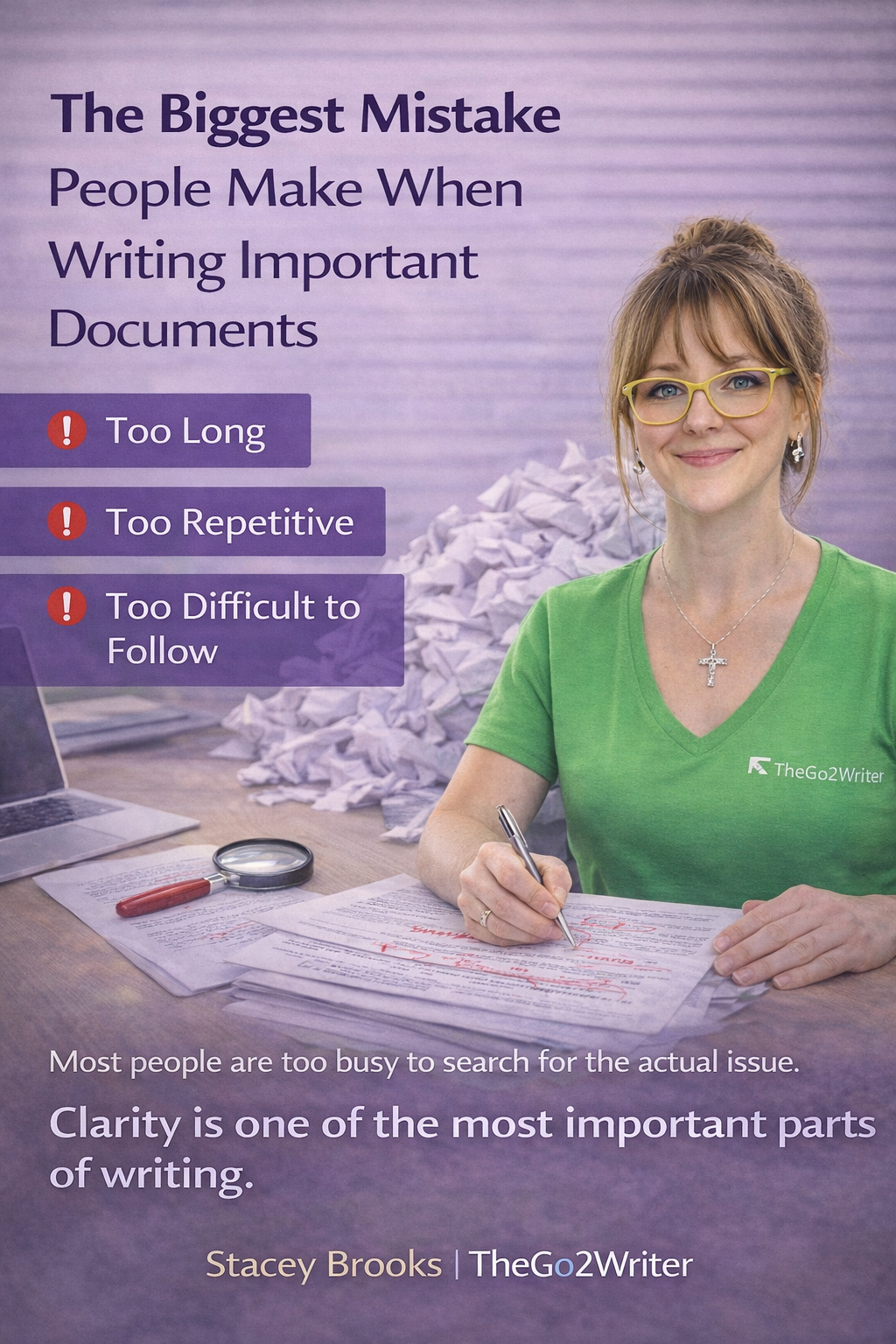
And before long, the document becomes too long, too repetitive, and too difficult to follow.

This is one of the biggest mistakes people make when writing important documents.

More information does not always make a document stronger.

In many cases, it makes it weaker.

That is because most people reading documents are busy.

Employers.
Appeal officers.
Credit bureaus.
Grant reviewers.
Government agencies.
Potential clients.

They are often reviewing dozens, if not hundreds, of documents.

They do not want to search through paragraphs of extra information to figure out what the actual issue is.

They want clarity.

A strong document gets to the point quickly.

It explains:

  • What happened
  • Why it matters
  • What facts support the situation
  • What outcome is being requested

That does not mean you leave out important details.

It means you choose the right details.

For example, many people writing an appeal will spend three paragraphs explaining how upset they are before they ever explain what actually happened.

Someone writing a complaint letter may spend most of the document venting instead of clearly stating the issue.

A business owner writing a proposal may spend too much time describing themselves and not enough time explaining the actual service they provide.

The strongest documents are usually the ones that feel organized and focused.

Every sentence has a purpose.
Every paragraph supports the main point.
Every detail helps the reader understand what matters most.

One helpful way to think about it is this:

If a detail does not help explain the issue, support the facts, or strengthen the request, it probably does not need to be there.

That is one of the reasons editing is so important.

Editing helps identify what should stay, what should be removed, and what needs to be reorganized.

Because when a document is clear and focused, it becomes much easier for the reader to understand.

And when people understand your message more easily, you have a much better chance of getting the result you want.

Stacey Brooks | TheGo2Writer

When You Don’t Know What to Say

There is a particular kind of stress that comes from needing to write something important and not knowing where to begin.

It might be a letter to an employer.
An appeal.
A business plan.
A response to an agency.
A difficult message that cannot be avoided.

Most people assume the problem is that they “are not good writers.”

That is rarely true.

The real problem is overload.

Too many thoughts at once.
Too much emotion attached to the situation.
Too much pressure riding on the outcome.

When the mind holds everything at once, clarity disappears.

Writing is not about fancy words.
It is about structure.

What is the purpose?
What must be communicated?
What tone is appropriate?
What outcome are we seeking?

Once those questions are answered, the fog begins to lift.

Clarity creates calm.
Calm creates confidence.
Confidence creates credibility.

From a faith perspective, there is also something grounding about remembering that truth does not require panic. If something needs to be said, it can be said with dignity and order.

Even difficult messages can be structured with steadiness.

When clients come to me overwhelmed, my role is not to take over their voice. It is to help organize it. To separate emotion from message. To make sure what matters most is not buried under stress.

If you are staring at a blank screen tonight, you are not incapable. You are likely just carrying too much at once.

And structure solves that.

Stacey Brooks
TheGo2Writer

This Valentine’s Day, Say It the Right Way

Today is about love.
Love for your spouse.
Love for your children.
Love for your business.
Love for the dream you are still building.
Sometimes the most important words are the hardest to write.
If there is something you have been meaning to say but have not known how to put into words, that is where I come in.
Whether it is:
• A professional resume, cover letter, or LinkedIn profile that needs to reflect your true experience and value
• A business plan, proposal, bio, or mission statement that needs structure and clarity
• A legal letter, appeal, formal complaint, or important response that must be written carefully and correctly
• A heartfelt letter to someone you love that feels difficult to put into words
• A personal statement for school, a scholarship, or a new opportunity
• Help organizing scattered thoughts into a clear, confident message
I help you say it the right way.
With clarity.
With professionalism.
With purpose.
This Valentine’s Day, give yourself the gift of confidence in your words. If something has been sitting unfinished, overwhelming, or weighing on you, message me. Let’s turn it into something strong, polished, and ready to send.
Follow this page for writing support, encouragement, and practical guidance.
Stacey Brooks | TheGo2Writer
x  Powerful Protection for WordPress, from Shield Security
This Site Is Protected By
Shield Security