Turn Scattered Thoughts, Notes, and Stress Into Clear Information That Is Easier to Write and Easier for Others to Understand
When people sit down to write an important document, most of the time they are not struggling because they do not know how to write.
They are struggling because they have too much information in their head all at once.
They are thinking about what happened, what they are feeling, what they forgot to mention, what they want to say, what they should leave out, what order things should go in, and whether the person reading it will even understand it.
That is where most people get stuck.
Before you ever start writing, the most important thing you can do is organize your information first.
A clear document almost always starts with clear notes.
Why People Struggle With Important Documents
Most people try to write while they are still sorting through their thoughts.
That usually leads to:
- Jumping around from topic to topic
- Repeating the same point several times
- Leaving out important details
- Adding emotional details that do not help
- Forgetting dates, names, or timelines
- Making the reader work too hard to understand the situation
Whether you are writing an unemployment appeal, hardship letter, business plan, complaint letter, grant application, resume, or formal explanation, the same rule applies:
The clearer your information is before you start writing, the stronger the final document will be.
Start With These Four Questions
Before you write anything important, stop and answer these four questions:
1. What happened?
Write down the situation in the simplest possible way.
Do not worry about perfect grammar. Do not try to sound professional yet.
Just explain the situation plainly.
Example:
“I lost my job after a misunderstanding with a supervisor and now I need to explain why I should qualify for unemployment benefits.”
Or:
“I want to start a business, but I have too many ideas and do not know how to organize them into a business plan.”
2. What are the most important facts?
Once you know the main situation, start listing the key facts.
This may include:
- Dates
- Names
- Timeline of events
- Important conversations
- Documents you already have
- Money amounts
- Deadlines
- Policies or rules
- Any evidence that supports your side
This is where many people realize they know more than they think they do.
3. What outcome do you want?
Many people spend so much time explaining the problem that they forget to clearly explain what they want.
Ask yourself:
- Do I want approval?
- Do I want reconsideration?
- Do I want someone to understand my side?
- Do I want an interview?
- Do I want funding?
- Do I want the reader to take a specific action?
If you do not know your desired outcome, the document will feel scattered.
A Simple Framework You Can Follow
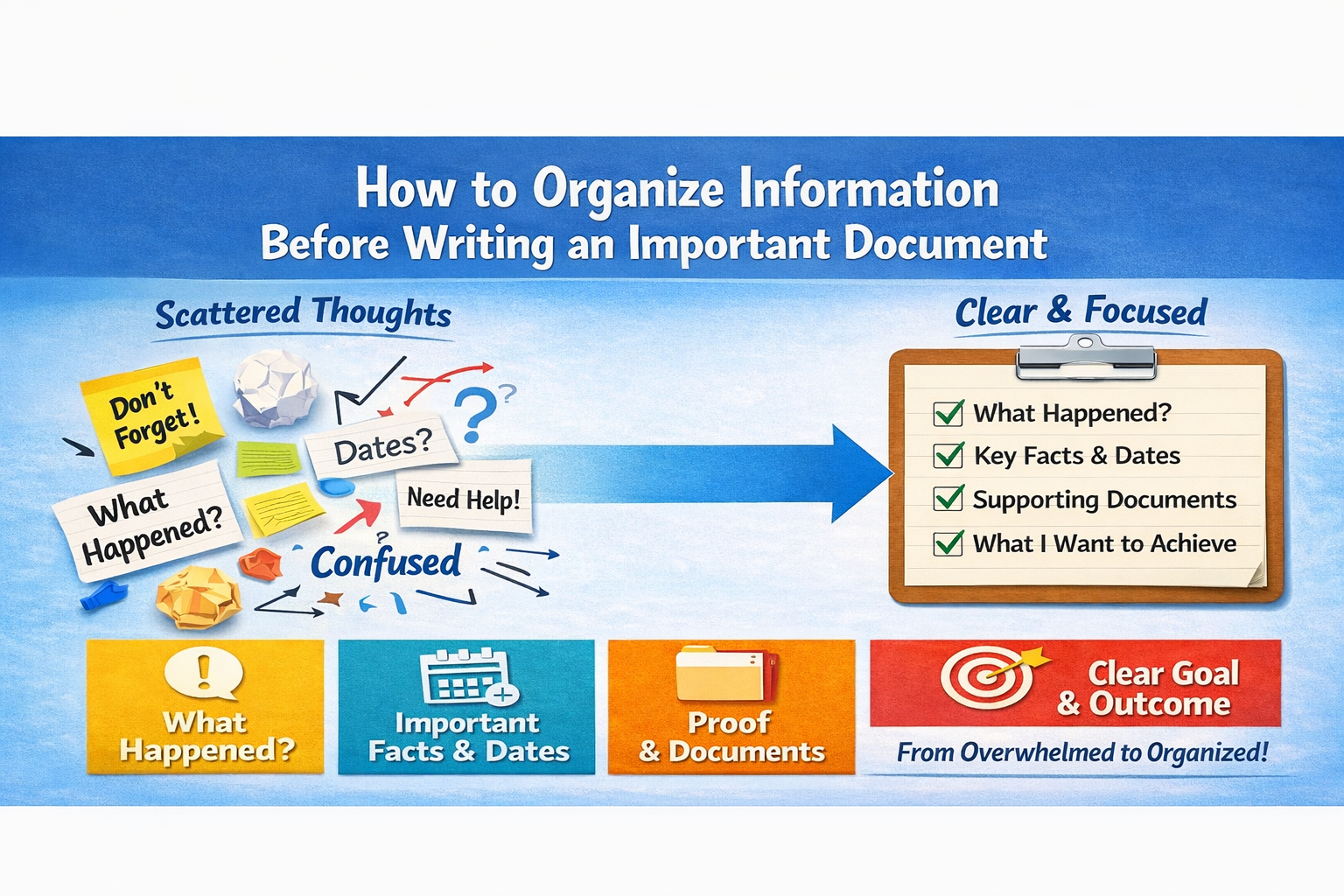
Most important documents can be organized into four sections:
- What happened
- Important facts and timeline
- Supporting documents or evidence
- What you are asking for
That simple structure works for almost everything.
It works for:
- Unemployment appeals
- Hardship letters
- Business plans
- Complaint letters
- Grant applications
- Professional emails
- Government paperwork
- Resumes and cover letters
- School or housing letters
Create a Master List Before You Write
One of the easiest ways to reduce stress is to create what I call a “master list.”
Your master list is simply a rough list of every important detail you can think of before you start writing.
You can include:
- Names
- Dates
- Important events
- Supporting documents
- Questions you need answered
- Points you do not want to forget
- Specific phrases you want included
- Contact information
- Deadlines
- Next steps
Once everything is written down in one place, your brain no longer has to keep trying to remember it all at once.
That makes writing much easier.
Why This Matters
Decision-makers do not spend hours trying to figure out what you mean.
Whether it is a hiring manager, judge, grant reviewer, government office, lender, landlord, or business owner, most people are quickly scanning for:
- What happened
- Why it matters
- What proof exists
- What you want them to do
The easier you make that process, the better your chances of getting a positive result.
Good writing is not just about grammar.
It is about clarity, structure, and helping the reader understand what matters most.
If you organize your information before you write, you will save time, reduce stress, and create documents that are much more likely to get results. One document at a time.
Stacey Brooks Thego2writer