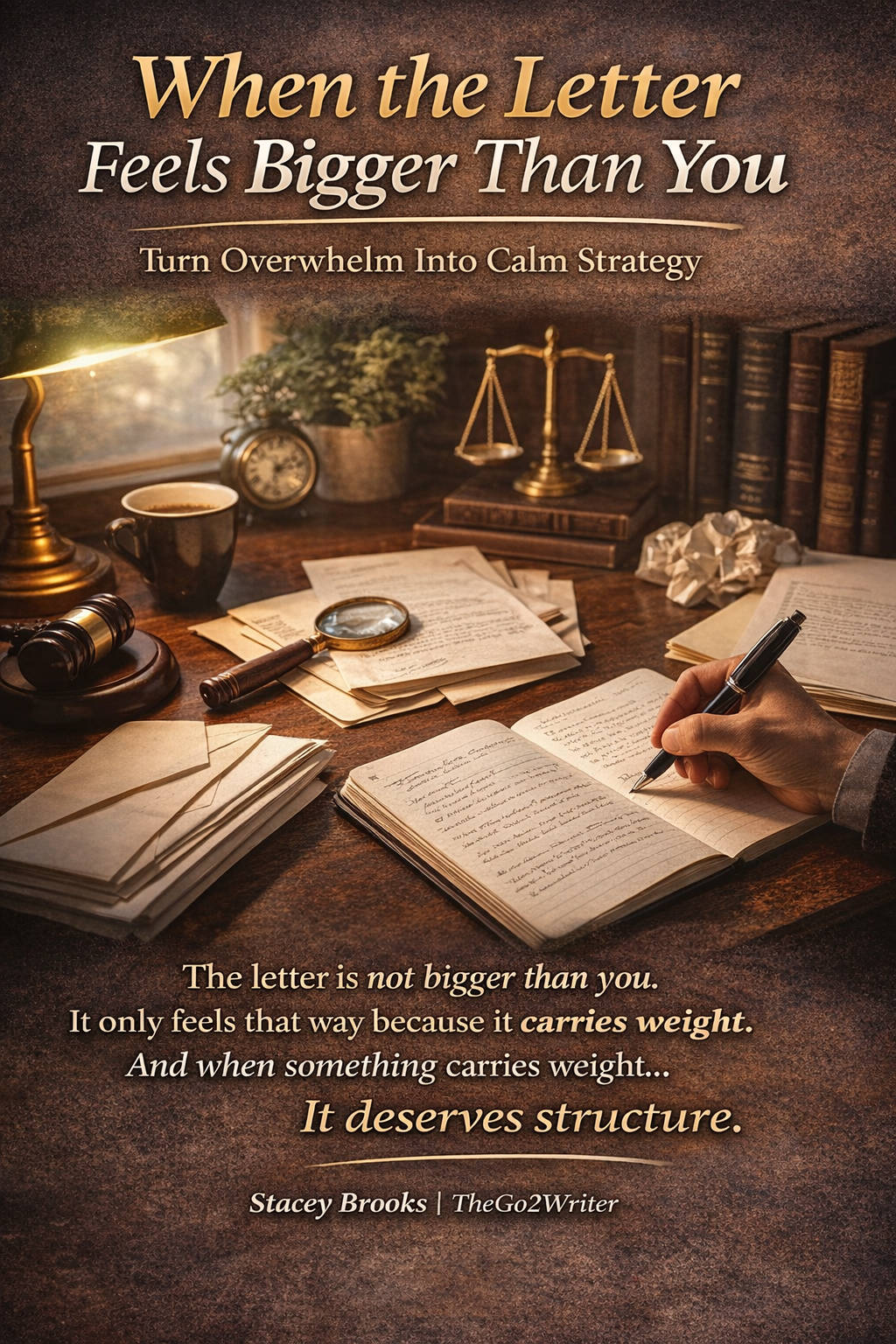
When the Letter Feels Bigger Than You

There is a specific kind of stress that happens when you know you need to write something important.

A dispute letter.
An appeal.
A formal complaint.
A response to a creditor.
A letter to a school, an employer, or an agency.

The moment you sit down to write it, everything feels heavy.

Your thoughts move too fast.
Your emotions sit too close to the surface.
Your words either come out too strong or not strong enough.

If you have ever felt this way, let me gently tell you something important:

The letter is not bigger than you.

It only feels that way because it carries weight. And when something carries weight, it deserves structure.

Why Important Letters Feel Overwhelming

Most people think they struggle with writing because they are not “good writers.”

That is rarely true.

The real issue is this: you are trying to process emotion and construct strategy at the same time.

That is exhausting.

When you are dealing with credit disputes, appeals, legal notices, financial hardship explanations, or professional complaints, you are not just writing. You are protecting your future. That pressure changes everything.

Calm Structure Changes Outcomes

Professional writing is not about sounding impressive. It is about being clear, organized, and intentional.

Here is what strong structured writing does:

It separates facts from emotion.
It organizes events into a timeline.
It removes unnecessary language.
It protects your credibility.
It strengthens your position.

Most importantly, it restores your confidence.

When a letter is structured properly, it stops feeling chaotic. It becomes controlled. Measured. Strategic.

And that shift alone can change the tone of the response you receive.

Clarity Creates Confidence

In many cases, the issue is not that people do not know what happened. They know exactly what happened.

They just have too much information in their head at once.

When everything is tangled together, it feels overwhelming. When it is separated into sections and presented calmly, it becomes manageable.

That is what clarity does. It reduces fear.

You Do Not Have To Face Important Paperwork Alone

There is nothing weak about asking for help with something that affects your finances, your reputation, or your future.

Strong people seek structure.

Wise people seek strategy.

And steady progress begins with calm, intentional action.

If you are sitting in front of a letter that feels too heavy to write, pause. Take a breath. Remember that structure changes everything.

You are not behind.
You are not incapable.
You are simply in a moment that requires clarity.

And clarity can be built.

Stacey Brooks
Professional Writing Services
TheGo2Writer.com

When Words Matter Most: How to Write Clearly in High-Pressure Situations

There are moments when writing is not optional.

It is not creative.
It is not casual.
It is necessary.

A resignation letter.
An appeal.
A complaint.
A formal request.
A response to an accusation.
A message to a school, employer, agency, landlord, client.

And in those moments, emotions are high. Thoughts are scattered. Stakes feel heavy.

This is where most people struggle.

Not because they lack intelligence.
Not because they do not know what happened.
But because pressure disrupts clarity.

Today’s post is practical. If you ever have to write something important under stress, here is how to do it well.

1. Separate Emotion From Structure

Emotion belongs in your experience.
Structure belongs in your document.

Before you begin writing the actual message, do this:

On a blank page, answer these three questions only:

  1. What happened?

  2. What do I want?

  3. What outcome would be reasonable?

Keep it short. Bullet points are fine.

This step prevents emotional spirals from overtaking your message. It gives your brain a container.

Once you have those answers, then you write.

2. Use the Professional Formula

Most high-stakes documents follow this simple structure:

Paragraph 1: Purpose
State why you are writing in one or two sentences.

Example:
“I am writing to formally request a review of the recent decision regarding my unemployment benefits.”

Clear. Direct. Calm.

2. Use the Professional Formula

Most high-stakes documents follow this simple structure:

Paragraph 1: Purpose
State why you are writing in one or two sentences.

Example:
“I am writing to formally request a review of the recent decision regarding my unemployment benefits.”

Clear. Direct. Calm.

Specific requests lead to actionable responses.

3. Remove Defensive Language

When people feel wronged, they often write in defense mode.

Phrases like:
“This is unfair.”
“You clearly did not review…”
“I cannot believe…”

These weaken your credibility.

Replace them with:
“According to the documentation provided…”
“Based on the timeline outlined…”
“I respectfully request clarification regarding…”

Calm language increases authority.

The goal is not to win emotionally.

The goal is to be taken seriously.

4. Short Sentences Win

Long paragraphs feel overwhelming to readers, especially decision-makers reviewing dozens of cases.

Keep sentences tight.
Break up paragraphs.
Use white space.

Clarity is kindness to the reader.

If a sentence runs longer than two lines, shorten it.

5. Always Attach Proof

Never rely on your explanation alone.

If you reference:
A payment
A deadline
A prior approval
A contract
A policy

Attach it.

Then reference it clearly in the document:

“See attached email dated January 12, 2026 confirming approval.”

Documentation strengthens your position more than emotion ever will.

6. Let It Sit

If possible, wait 12 to 24 hours before sending.

Re-read and ask:

Is this clear?
Is this respectful?
Is this specific?
Does this document help the reader make a decision?

If the answer is yes, send it confidently.

7. When You Feel Stuck

Sometimes the issue is not grammar.
It is overload.

When someone says, “I do not even know how to start,” what they usually mean is:

“I am carrying too much at once.”

That is not a writing problem.
That is a processing problem.

Break it down.
Extract the facts.
Structure the request.
Then polish the tone.

Writing under pressure is not about being eloquent.
It is about being clear.

Final Thought

The most powerful documents are not loud.
They are steady.

Calm writing communicates credibility.
Structure communicates confidence.
Clarity communicates strength.

And when the stakes are high, strength on paper matters.

If you ever find yourself staring at a blank screen with something important on the line, remember:

You do not have to write perfectly.
You just have to write clearly.

That is what moves things forward.